
During a shift, the next call could come in a minute — or in an hour. When it does, there’s no time to wait for the temperature inside the ambulance to become comfortable. During periods of extreme heat, an ambulance sitting in the sun can quickly build up heat, affecting the comfort of both paramedics and patients.
But even the best heating, ventilation, and air conditioning (HVAC) system isn’t necessarily the most powerful one. It’s the one that best matches the fleet’s operating conditions. At Demers, three levels of HVAC performance allow the ambulance to be matched to its operating environment:
- The standard system, designed to meet applicable requirements and the operating needs of most emergency medical services;
- The high-performance system, which adds an independent HVAC system dedicated to the patient compartment;
- Arctic Range, developed for much more demanding environments, including regions exposed to extreme heat.
One ambulance, different operating realities
HVAC needs can vary considerably from one service to another based on factors such as dynamic deployment versus returning to a station between calls, short urban transports versus long-distance travel, and dry heat versus hot and humid conditions.
Before choosing an HVAC system, consider six questions:
- What climate will the ambulance operate in?
- Is high humidity common?
- How much time does the vehicle spend stationary between calls?
- Are transports generally short or long?
- Does the ambulance return to a station or operate under dynamic deployment?
- How quickly do you need the patient compartment to reach a comfortable temperature?
“Historically, this wasn’t necessarily as significant an issue. But today, it’s becoming an increasingly relevant investment.”
— Andréane Kirouac, Quebec Regional Sales Representative, Demers Ambulances
Why an independent system makes a difference
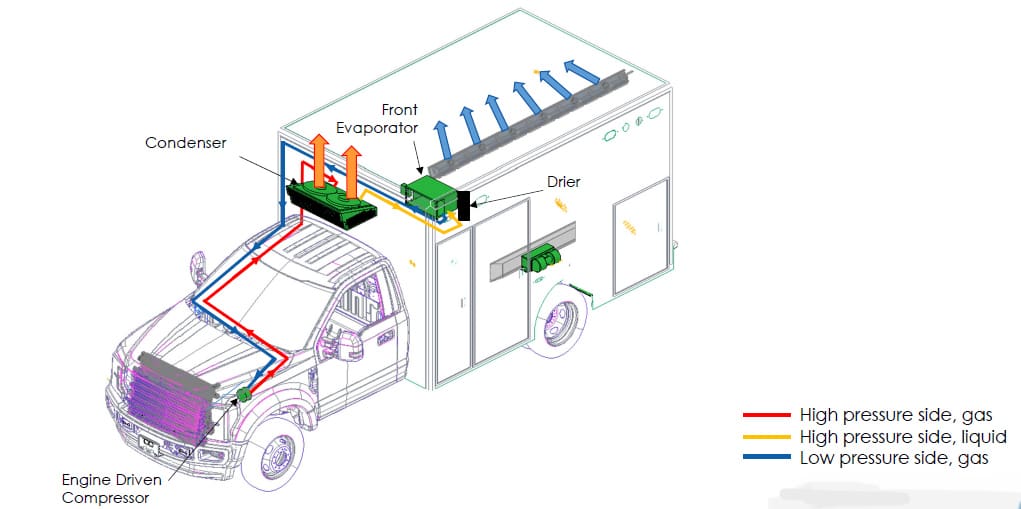
In Type I and Type III ambulances, the chassis air conditioning system is primarily designed for the front cab. On several Ford configurations, that same system also supplies cooling to the patient compartment while meeting applicable requirements.
The high-performance option adds a second, completely independent circuit with its own compressor, condenser, and evaporator. While the chassis system cools the cab, the second system is dedicated to the patient compartment.
The result is faster cooling and greater temperature stability when conditions become particularly demanding — an important consideration when transport times are short, and there is little time for the patient compartment to cool down.
Performance is about more than BTUs
“It’s not as simple as saying, ‘I want more BTUs.’ If one component is much more powerful than the others, the rest of the system can become the limiting factor. You can even end up paying more for technology that doesn’t deliver the expected improvement. That’s why we look at the system as a whole and then measure its performance in a climatic chamber.”
— Antoine Shryer, Engineer, Demers Ambulances
In 2026, Demers also introduced a new front-condenser design that can accommodate different condenser models offering equivalent or greater performance. This flexibility can also make parts more readily available for maintenance and repairs.
Insulation plays an important role as well. By limiting heat transfer between the patient compartment and the outside environment, effective insulation helps the HVAC system reach and maintain the desired temperature more efficiently.
Laboratory testing that meets the realities of emergency response
“Standards are there to define the minimum criteria. Beyond that, it becomes a decision for the user and the buyer.”
— Richard Potvin, Project Manager, Product Certification – Engineering, Demers Ambulances
Demers also uses an internal testing protocol to assess cooling speed, the lowest temperature the system can achieve, and recovery after the doors have been left open under more demanding conditions.
These tests provide a better understanding of how the system responds before it encounters actual variables such as humidity, solar heat gain, and extended periods of idling.
Planning for today’s comfort and tomorrow’s fleet
Choosing an HVAC solution isn’t limited to the purchase of a new ambulance. Depending on the age of the fleet and the organization’s priorities, a higher-performance solution may also be considered as part of a remount or through planned upgrades.
For organizations considering a gradual approach, Andréane Kirouac recommends establishing a schedule to convert vehicles when appropriate rather than upgrading the entire fleet at once. This can help spread investments over time while progressively improving working conditions for crews.
Finally, even the best HVAC system cannot deliver its full potential without proper preventive maintenance. Regular inspections are essential to maintaining performance and helping keep ambulances available year after year.
To learn more, read our article “The Importance of Preventive Maintenance for Your Ambulance HVAC System.”
To assess which HVAC solution best fits your fleet and operating conditions, contact your Demers representative.