


Our Ambulances
Designed For the People Who Use Them
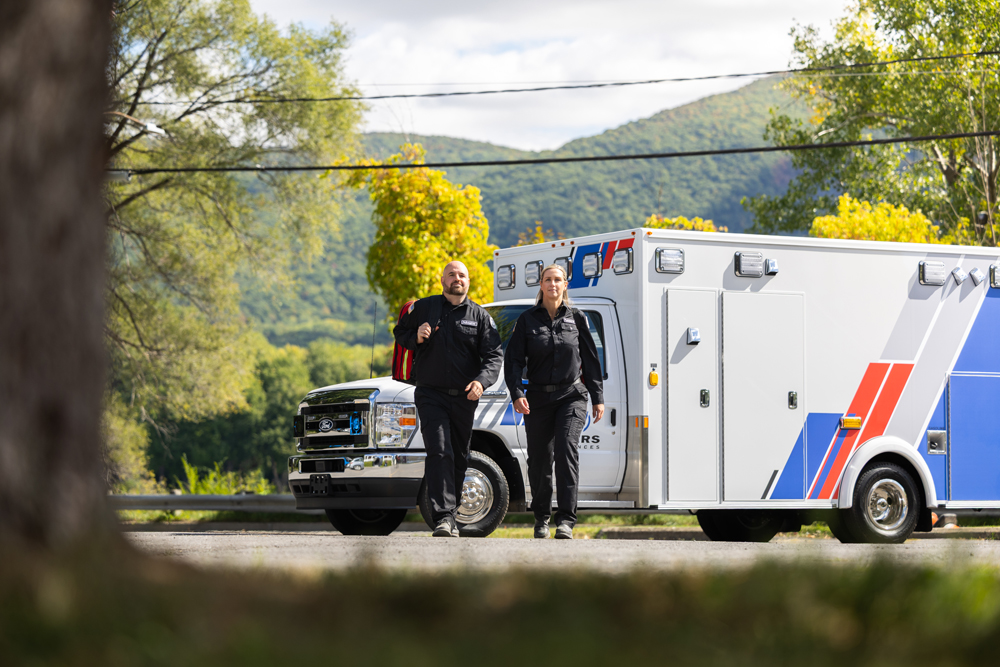
New Ambulances That Work For You
As a leading ambulance manufacturer, we design every ambulance with one priority in mind: supporting the EMS professionals who rely on them every day. Every model is purpose-built to improve how crews work, move, and deliver care. From ergonomic layouts to durable construction, our ambulances perform reliably in real-world EMS environments.
Whether you’re researching new ambulances for fleet expansion, replacement, or a first-time purchase, this page provides a high-level overview of Demers ambulances — what they share in common and how to explore options by model, type, or chassis.
Find the Right Ambulance For Your Crew
Choosing an ambulance is a long-term decision. We build on proven platforms, focus on ergonomic design, and engineer every model to support you.
What All Demers Ambulances Have in Common
Regardless of type or chassis, every Demers ambulance is built on the same foundation of quality, consistency, and intentional engineering. Each model reflects proven engineering, EMT-centric layouts shaped by real-world feedback, and a commitment to crew safety, comfort, and long-term durability.
Whether Type I, Type II, or Type III, we select and refine materials, systems, and layouts to deliver reliable performance, ergonomic efficiency, and adaptability as EMS demands evolve.

Proven Innovations Across Every Model
Every Demers ambulance includes performance-driven features designed to make the job easier, safer, and more efficient.
Multiplex Electrical System (MMC)
Delivers reliable power distribution with built-in diagnostic capabilities that reduce troubleshooting time, minimize downtime, and keep your unit in service when it’s needed most.
High-Visibility Flush Mount Windows
Enhance situational awareness for safer response while maintaining a sleek, professional fleet appearance. Flush-mount construction eliminates leak points and reduces long-term maintenance demands.
Lightweight Design
Engineered to reduce overall vehicle weight without sacrificing structural strength—improving handling, increasing payload capacity, and lowering fuel costs over the vehicle’s service life.
Clever Cabinetry
EcoSmart Technologies
Combines aerodynamic engineering, weight optimization, and intelligent power systems to lower fuel consumption, reduce emissions, and decrease lifecycle operating costs without compromising vehicle durability or crew safety.
Anti-Idling System
Reduces unnecessary engine runtime during scene standby and patient care, cutting fuel costs and engine wear while ensuring continuous power for HVAC, lighting, and medical equipment through smart load management.
Independent Ducted Heat & AC
Provides dedicated climate control for the patient compartment, allowing crews to maintain comfortable working temperatures and appropriate patient care conditions without running the engine—reducing fuel consumption and engine wear during extended scene times.
Double Door Seals
Engineered dual-seal design creates redundant protection against water leaks, dust infiltration, and air loss—improving climate control efficiency, reducing interior noise, and extending seal durability in demanding conditions.
4-Point Safety Belt System
Provides superior occupant restraint with four anchor points that distribute crash forces more effectively than traditional 3-point belts—reducing injury risk during emergency driving and collision events.
What You Need to Know Before Buying A New Ambulance
If you are early in the process of purchasing a new ambulance, the information below addresses the most common questions we hear.
What should you consider before choosing an ambulance?
Before choosing a new ambulance, understand how the vehicle will be used day-to-day. Call volume, service area, patient care requirements, and crew workflows all influence which type, chassis, and configuration will best fit your operation. Consider which features are standard versus optional, how customization works, and how design decisions affect safety, ergonomics, maintenance, and long-term durability. Working with an authorized Demers dealer partner early in the process helps align specifications, timelines, compliance requirements, and long-term support, resulting in an ambulance that fits your operation and delivers lasting value.
How do I find the right ambulance for my fleet?
Selecting the right ambulance requires more than comparing spec sheets—it requires understanding your operation. Call volume, response area geography, patient acuity, crew size, and equipment requirements all factor into the decision. Demers manufactures Type I, Type II, and Type III ambulances, each designed for distinct operational profiles. Your authorized Demers dealer partner evaluates your current fleet utilization, identifies gaps or inefficiencies, and recommends the model and configuration that aligns with how your agency actually operates—not just how you think it should.
How customizable are Demers ambulances?
Our ambulances offer a high level of customization without starting from scratch. Your authorized Demers dealer partner will help you select the right base model for your operational needs, then work with you to tailor layouts, equipment, and features to match your protocols and workflow. This approach ensures the ambulance fits how you operate while maintaining quality, efficiency, and compliance.
How long does it take to receive a new ambulance?
Lead times depend on model selection, specification complexity, and production schedules. Delivery timelines are established at order placement, and your authorized Demers dealer partner provides regular production updates to keep you informed throughout the build cycle. This transparency allows you to coordinate fleet planning, staffing, and budget execution around confirmed delivery dates rather than estimates. Consider incorporating remounting into your procurement strategy—it provides flexibility to address immediate needs while new units are in production.
How does Demers compare to other ambulance manufacturers?
It’s true, not all ambulances are designed the same. Demers prioritizes intentional, purpose-driven engineering over feature bloat. Every layout and system is developed with direct input from EMS professionals who use our ambulances in the field. We don’t add complexity for its own sake — we solve real problems that affect crew safety, operational efficiency, and patient care quality. That’s the difference between designing ambulances and engineering solutions for first responders.
What standards and certifications do Demers ambulances meet?
Demers ambulances are engineered to meet or exceed all applicable industry standards and certifications. Compliance isn’t optional—it’s foundational to how we build. Our certifications include:
- ISO 9001:2015
- Ford Pro Upfitter certification
- KKK-A-1822F
- CAAS Ground Vehicle Standard (GVS)
- FMVSS (Federal Motor Vehicle Safety Standards)
How are Demers ambulances tested?
We design and build ambulances with a clear, disciplined focus on how EMS professionals actually work. Our design decisions are guided by direct input from first responders and validated through rigorous 3rd party testing, not by adding features for the sake of complexity. We prioritize workflow, ergonomics, safety, and long-term performance, ensuring that every layout, system, and component serves a real purpose in the field. This intentional, feedback-driven approach results in ambulances that are easier to use, safer for crews, and reliable throughout years of frontline service.
What is the average lifespan of a Demers ambulance?
Service life varies based on call volume, operating conditions, and maintenance protocols, but Demers ambulances are built to withstand years of demanding frontline use. Our engineering prioritizes structural integrity and long-term durability, enabling extended service across diverse operating environments. When your chassis reaches its limit, remounting offers a cost-effective way to extend vehicle life by transferring your Demers module to a new chassis—protecting your original investment while maintaining the features and layouts your crews rely on.
What warranty comes with a Demers ambulance?
We stand behind every ambulance we build with comprehensive, confidence-building warranty protection. A new Demers ambulance is covered by a limited warranty that protects against defects in materials and workmanship. Covered repairs are completed at no charge within the warranty period.
Beyond the warranty itself, our commitment extends to responsive support and clear communication. We work closely with our authorized dealer network to ensure questions are addressed promptly and issues are resolved efficiently, helping you keep your ambulance in service and your crews supported throughout ownership.
How are Demers ambulances supported after delivery?
Support doesn’t end at delivery—it starts there. Demers ambulances are backed by a nationwide network of authorized dealer partners and by Demers as the manufacturer. Your local dealer provides responsive service, parts availability, and warranty support with direct access to our engineering and manufacturing teams. This ensures faster troubleshooting, reduced downtime, and sustained performance throughout your ambulance’s service life. We stand behind what we build.
Engineered to place frequently used equipment within optimal reach zones, reducing physical strain, accelerating supply access, and improving workflow efficiency during time-critical responses.