


Why Demers
Thoughtfully Engineered, Trusted on Every Call

Choosing an ambulance manufacturer is about more than features. It is about how engineering and manufacturing come together to support safety, reliability & performance, serviceability, and total cost of ownership over the life of the vehicle.
At Demers, we intentionally design ambulances as complete systems, with engineering, production, and testing validation working together from the start to ensure consistent performance in real EMS environments.
What sets Demers apart from other ambulance manufacturers is not a single feature or innovation, but the discipline behind how our ambulances are designed, manufactured, and validated before they enter service. This engineering-first approach is the foundation of “The Demers Difference” and why our ambulances deliver dependable, long-term, proven performance.
“The Demers Difference”
Our ambulances are engineered from the ground up to perform reliably in real-world EMS environments. Systems are designed to work together from the start, ensuring they are integrated into the vehicle rather than retrofitted later.
This approach ensures:
- Structures are designed for durability and safety
- Systems function as a cohesive environment
- Service access is considered before delivery
- Performance is predictable over the ambulance’s service life
That depth of engineering is why our ambulances feel purpose-built, not pieced together.


Exclusive Innovations
Demers’ innovations are intentionally built into the ambulance, not added on afterward. Because engineering and production are fully integrated, we can pioneer systems at their core and envision and design how they work together from the start, rather than layering complexity later.
This approach allows us to deliver innovations such as:
- Proprietary seating designed around movement and restraint
- Industry-leading climate systems that are engineered for the patient compartment to maintain reliable comfort in all conditions
- Electrical architecture that simplifies control and diagnostics
- Storage systems designed around reach zones and real EMS workflows
Each innovation reflects insights from customers, dealer partners, and industry experts, supported by disciplined engineering, controlled manufacturing, and real-world validation.
Driven By Industry Insight
At Demers, innovation starts with the people who use our ambulances every day. We work closely with EMS professionals, dealer partners, fleet managers, and industry experts to understand evolving challenges, caregiver workflows, and emerging needs in the field.
These insights, combined with ongoing market research and real-world feedback, help guide our design, engineering, and refinement of ambulances. By staying closely connected to the EMS community, we can anticipate future demands and develop solutions that support the next generation of emergency care.
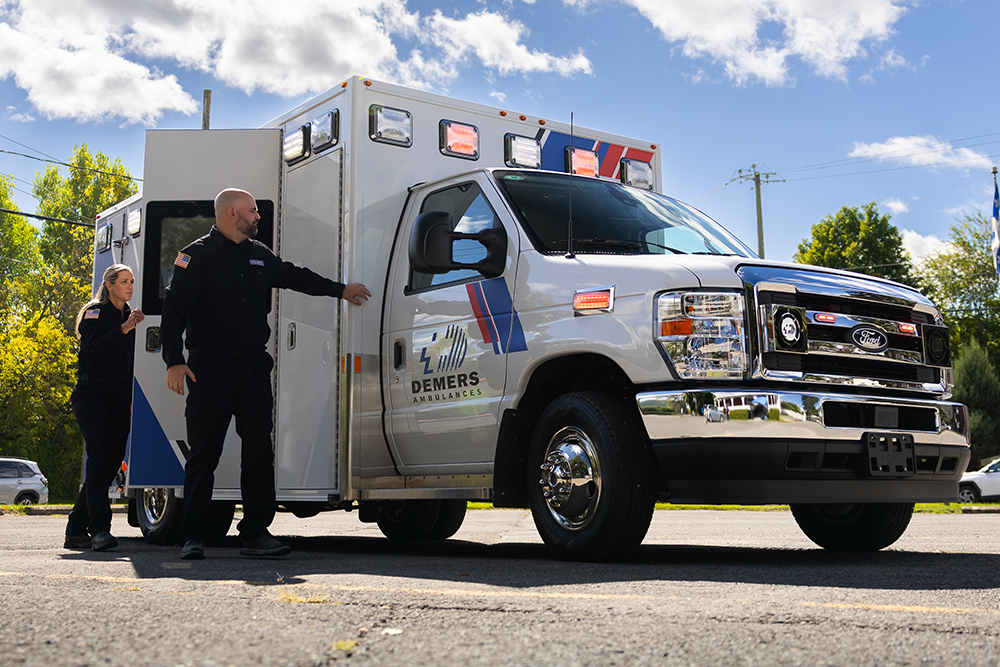
Purpose-Built Construction, Testing & Serviceability
Every Demers ambulance is engineered as a complete system, starting with high-quality materials and deliberate construction choices. All-aluminum construction provides strength, corrosion resistance, greater payload capacity, and weight efficiency while supporting easier sanitation and long-term structural consistency.
Each ambulance is built and tested to meet or exceed demanding industry safety standards across the United States. Most validation is conducted by qualified engineering and authorized testing teams, with certified third-party laboratories supporting specialized testing when required. This ensures safety, compliance, and performance are proven through validation, not assumptions.
That same engineering discipline extends to long-term serviceability. Modular, service-friendly systems simplify diagnostics, repairs, and maintenance, with organized, accessible components that help technicians work efficiently and support consistency across your fleet. The result is reduced downtime, more predictable lifecycle costs, and longer service life, supported by our authorized dealer network, OEM parts availability, and technical teams who understand how our ambulances are designed and built.
Why Demers? Frequently Asked Questions, Answered.
The questions below address how we innovate, engineer, manufacture, and validate ambulances, and why those decisions matter to safety, reliability, serviceability, and long-term ownership. These answers are intended to help you understand what to look for when evaluating an ambulance manufacturer and how Demers’ approach supports real-world EMS operations.
What should you look for when choosing an ambulance manufacturer?
It’s important to look beyond features and focus on how ambulances are engineered, built, tested, and supported. Key considerations include material choices, system integration, serviceability, compliance, and the manufacturer’s ability to support the vehicle long after delivery.
An ambulance built with engineering discipline and manufacturing consistency is more likely to perform reliably in the field and remain dependable throughout its service life.
Why does engineering-led manufacturing matter in ambulance design?
Ambulances are complex, mission-critical vehicles. Engineering-led manufacturing ensures systems are designed to work together before production begins, rather than being layered on later.
At Demers, engineering ensures that the structure, electrical system, HVAC, seating, and storage are integrated. The result is an ambulance that feels cohesive, reliable, and purpose-built, not a collection of separate parts.
How does the way an ambulance is built affect the total cost of ownership?
Manufacturing decisions directly impact how long an ambulance stays in service and how much it costs to maintain. Durable materials, integrated systems, and service-friendly design reduce downtime, limit unexpected repairs, and extend useful life.
By focusing on long-term reliability rather than short-term savings, we help you control lifecycle costs and protect your investment over time.
How does modular ambulance construction improve serviceability and uptime?
Modular construction allows systems to be accessed, serviced, and replaced without unnecessary disassembly. Components are organized, logically placed, and designed with service access in mind. For fleet managers and technicians, this means faster diagnostics, quicker repairs, and less time out of service.
Over the life of the ambulance, modular design helps maintain uptime and reduces frustration during maintenance.
How does Demers maintain compliance when customizing ambulances?
Customization at Demers starts with engineering, not as an afterthought. Every configuration is designed within an engineered framework that already meets or exceeds applicable standards.
Rather than adding components in ways that create risk or complexity, options are integrated into the design and validated through testing. This ensures that custom builds remain compliant, safe, and reliable while still meeting your department’s operational needs.
How does Demers test ambulances to ensure long-term reliability?
Testing is a core part of our ambulance-building process. Most validation is performed in-house by dedicated testing and certification teams, allowing close control over quality and early identification of issues.
When specialized testing is required, certified third-party laboratories are used. Vehicles are built and tested to meet or exceed the most demanding applicable standards across regions, ensuring safety, compliance, and performance are proven before delivery.
What is the difference between aluminum and composite ambulance construction?
The difference comes down to durability, consistency, and long-term reliability. Composite or wood-based structures may reduce upfront cost, but they can be more susceptible to moisture damage, delamination, and long-term wear.
Aluminum construction provides a more consistent structure that resists corrosion and environmental damage. This helps maintain strength, fit, and finish over time, which is especially important in high-use EMS operations where ambulances are exposed to constant cleaning, temperature changes, and daily wear.
What are the benefits of an all-aluminum ambulance body?
An all-aluminum ambulance body offers long-term durability, corrosion resistance, and weight efficiency. Aluminum does not absorb moisture, warp, or degrade as wood or some composite materials can, helping maintain structural integrity over years of heavy use.
That means a body that holds up better in demanding environments, is easier to clean and sanitize, and contributes to predictable performance throughout the ambulance’s service life.