


Inside every patient compartment, first responders make split-second decisions while working in a moving vehicle. For decades, that reality has forced EMS crews into a compromise: stay buckled and lose access to critical equipment or unbuckle and compromise their own safety to deliver effective patient care.
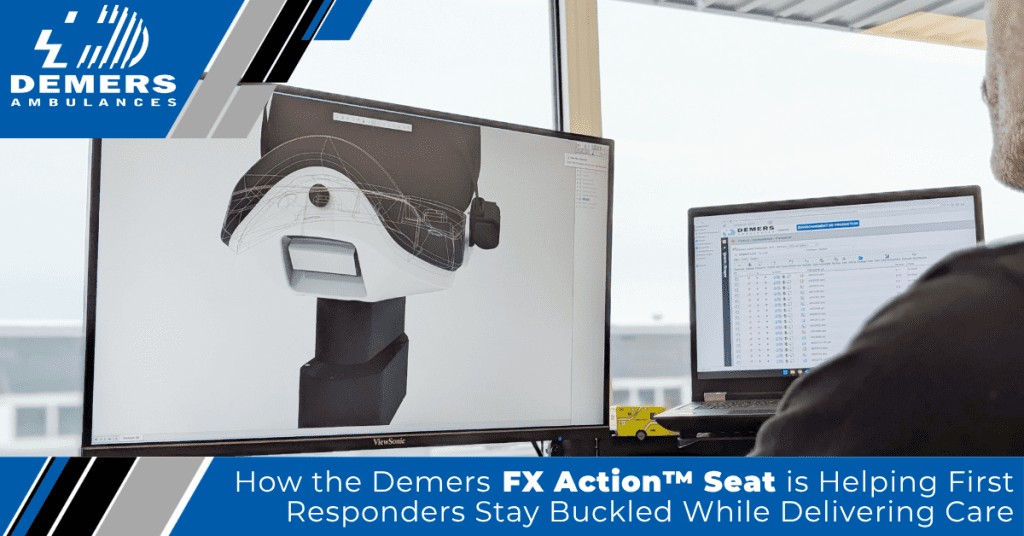
Demers Ambulances set out to eliminate that compromise. The result is the FX Action™ Seat, one of the defining innovations inside the FXP 174 Type I ambulance. Developed alongside first responders through real-world scenario re-enactments, design focus groups, ergonomics evaluations, prototyping, and extensive testing, the seat was created in response to a challenge crews have faced for years. EMS providers needed a seating solution that matched the realities of everyday patient care while improving safety, mobility, and workflow inside the patient compartment.
That demand ultimately helped shape the FXP 174 and its focus on a safer, more ergonomic patient care environment.
Designed Around Real EMS Movement
The FX Action™ Seat was engineered with one goal in mind, says Demers engineer Antoine Schryer.
“The true problem the FXP 174 addresses is keeping the EMS crew seated and belted while providing patient care,” Schryer explains.
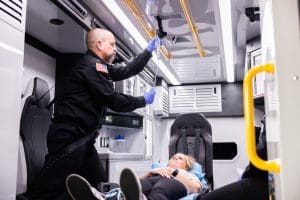
Inside an ambulance, even everyday road conditions create real safety risks for an unrestrained provider. Sudden stops, evasive maneuvers, sharp turns, and collisions can quickly turn the patient compartment into a dangerous environment. Yet for years, many first responders have had little choice but to unbuckle in order to reach equipment, reposition around the patient, or deliver care effectively.
The FX Action™ Seat was designed to work with first responders while eliminating the need to unbuckle.
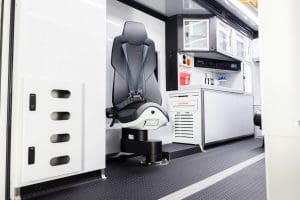
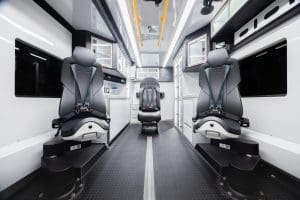
Unlike traditional side-facing seats that restrict movement, the FX Action™ Seat features a pivoting, sliding mechanism that allows paramedics to move laterally along the stretcher while remaining safely restrained. Providers can access equipment, reposition themselves, and administer care from head to toe without repeatedly standing up or removing their seatbelt.
The movement is controlled through an intuitive front-mounted button and an accessible adjustment lever beneath the seat. The saddle-style design was intentionally developed to improve ergonomics while maximizing mobility in tight patient care environments.
For crews, the experience feels less restrictive and more natural. For agencies, it represents a meaningful advancement in occupant safety. Discover how the innovation works in this video.
Safety Without Sacrificing Efficiency
Demers engineers understood from the beginning that innovation alone was not enough. The seat needed to prove itself under real-world conditions.
To validate the FX Action™ Seat, Demers conducted extensive testing focused on safety and long-term reliability.
That testing included:
- Cyclical durability testing designed to simulate years of daily EMS operations and confirm a lifespan equivalent to — or longer than — the ambulance itself.
- Destructive pull testing to evaluate floor anchors, seat belt assemblies, and aluminum seat bases under progressive force.
- Dynamic deceleration testing using crash-test dummies in multiple seating configurations to simulate frontal and lateral impacts.
- Ergonomic evaluations completed alongside paramedics and ergonomics specialists using a mobile laboratory environment.
The seats are also validated against applicable FMVSS and SAE testing requirements, ensuring they meet mandatory and voluntary safety standards and industry best practices.
The outcome is a seating system designed to exceed expectations for both crew safety and operational performance.
Built From First Responder Feedback
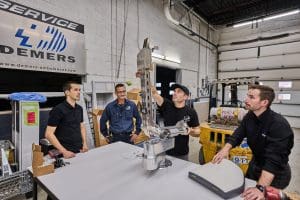
The FXP 174 platform was not developed in isolation. According to Schryer, first responder input shaped the platform from the earliest conversations through final design decisions.
“We really worked closely with our customers to tailor the FXP 174 to meet and basically exceed market needs,” Schryer says. “They saw the potential of the FX Action™ Seats, and it was up to use to create a solution that maximized that potential in a layout that works for them.”
Demers engineers conducted focus groups with EMS professionals and consistently gathered feedback during prebuilds, inspections, trade shows, and customer conversations across North America.
Every design decision reflects the same philosophy that defines the Demers Difference: improve the crew experience through intentional engineering.
Challenging the Status Quo in EMS
EMS providers have always prioritized patient care, often at the expense of their own safety. Demers believes ambulance design should help change that reality.
“EMS first responders will always prioritize their patient over their own safety,” Schryer explains. “It’s really up to leaders and agencies to provide the proper tools to their first line care providers that keep them safe while allowing them to work without constraints.”
The FX Action™ Seat represents a shift in thinking for the industry. Instead of asking providers to adapt to the ambulance, the ambulance adapts to the way providers actually work.
That philosophy aligns directly with Demers’ commitment to intentional, provider-focused design: building safe, ergonomic, feature-rich ambulances engineered around real-world EMS challenges.
A Glimpse Into the Future
For Demers, the FX Action™ Seat is not the finish line. It is the beginning of a broader evolution in ambulance design.
“To me, the FXP 174 is a gateway to the future,” Schryer says. “The seat is just a stepping stone, and there’s a whole bunch of other technologies that could just make life easier and safer for EMS providers.”
As EMS agencies continue searching for ways to improve provider retention, reduce injuries, and create safer patient care environments, innovations like the FX Action™ Seat will continue shaping the future of the ambulance industry.
To learn more about the FX Action™ Seat and how the innovation is providing a safer working environment for first responders, visit the Demers Ambulances FX Action™ Seat innovation page.